
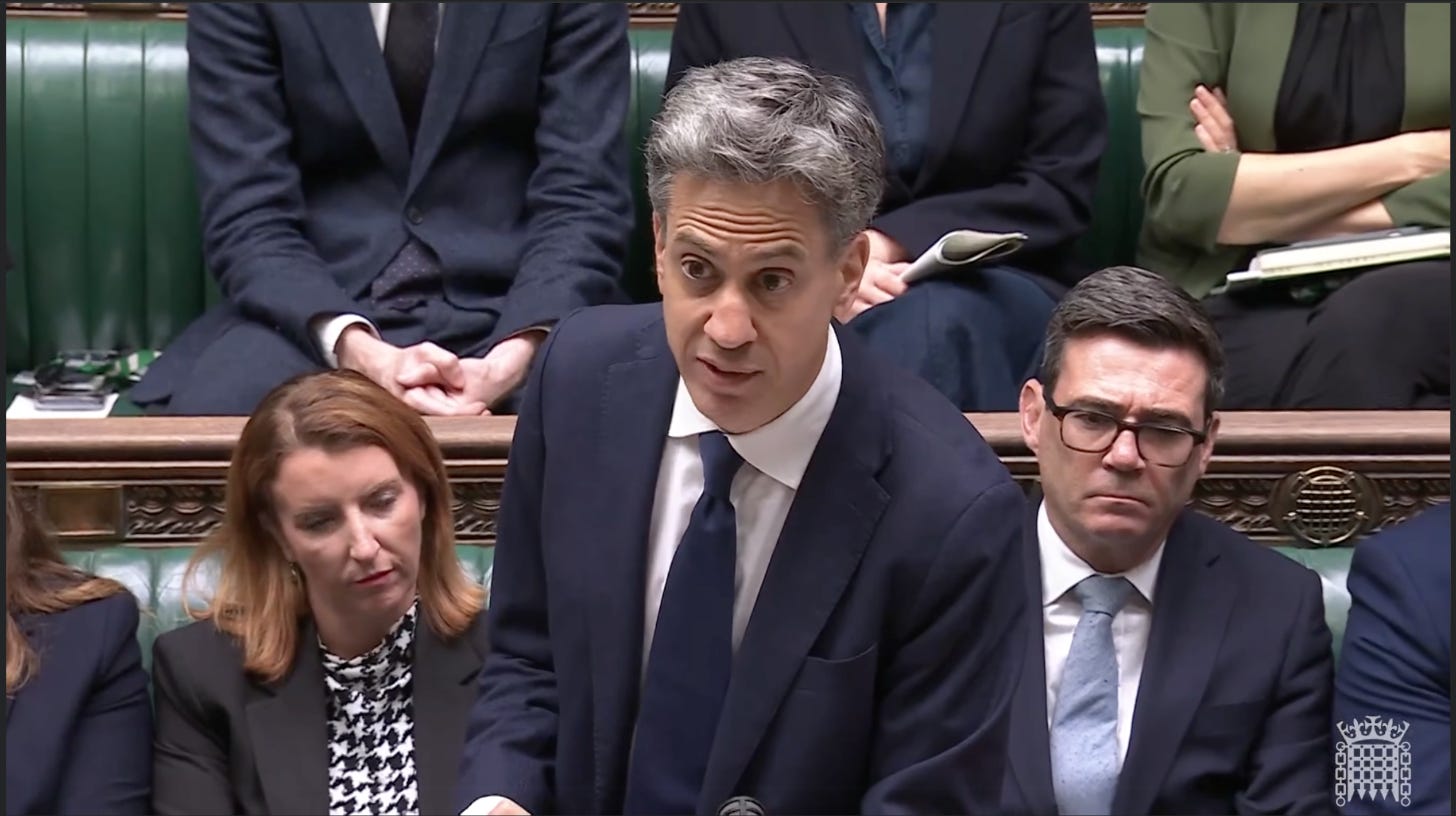
There is a distinct anxiety that grips a technocrat when the spreadsheets stop working. For years, the dominant class of British politics—personified by the bloodless, managerial styles of figures like David Cameron, Keir Starmer, Andy Burnham and Ed Miliband—assured us that governance was simply a matter of proper administration. We were told that if we just adjusted the right fiscal levers, followed the prescribed “expert” consensus, and nudged the public into the correct behavioural boxes, society would run like clockwork.
But technocracy is hitting a wall. The managerial project has run out of managerial ideas, leaving us all starved of meaning, belonging, direction—and representation. And the response from these stranded managers points to increasingly darkening times.
Get Britain Believing Again
In July, Prime Minister Andy Burnham talked of “getting Britain believing again”, offering as his vision: limiting bus fares to £2 and opening a “Number 10 North”.
This week he repeated the call; in a Guardian article and on social media he said: “It is more important than ever that Britain stands for something.”
But the problem is that if technocrats had any capacity to create a vision, they wouldn’t be technocrats. A manager is ill-equipped to become a prophet. So what happens when a politician who possesses no organic vision is suddenly called upon to manufacture one?
Obsessively Anti-Israel
The manager-turned-visionary does not build; they attack, and when they can, they will reach for an easy, pre-packaged moral framework.
Tragically, today that framework is an obsessive, reactionary focus on Israel. Lacking the capacity to inspire a positive domestic identity, these leaders are now turning to negative solidarity; they are attempting to unite a fractured public not by what they love or by what inspires them, but by who they might collectively oppose.
And we are seeing this now in the aggressive positioning from Foreign Secretary Ed Miliband, who has used his platform to cast Israel as the sole cause of a manufactured humanitarian catastrophe—accusing it of blocking medicine and causing children’s deaths, on the strength of nothing more than “stories” he says he’s heard—all backed by his boss, Andy Burnham.
All of this ‘works’ as a moral framework, because the obsession with Israel, the vitriol directed at it, has the appearance of being progressive; it is a dangerous, hateful unity of virtue.
“The Muslim Vote”
Too many commentators are dismissing this shift as mere electoral mathematics, chalking it up to a cynical play for the “Muslim vote”. But that analysis misses a far deeper and more alarming reality. First, it ignores the genuine, decades-long ideological conviction of figures like Miliband, who have consistently felt the need to attack Israel. Second, and more importantly, it fails to see that this is not just a tactical campaign strategy. This is a deliberate attempt to create “something to believe in”.
When Burnham writes in The Guardian that Britain must “stand for something” and enforce these new “values” via international sanctions, he is elevating hostility toward Israel into a core British value. This is a terrifying development. When a government defines its collective moral identity around the isolation of a single democratic state, the boundary between foreign policy and prejudice entirely dissolves.
Worse still, in their desperate rush to adopt a posture of absolute moral certainty, their rhetoric regularly bleeds into something far darker. By treating Israel as a unique, cosmic malevolence to prove their own ethical credentials, they frequently employ tropes of outsized power and hidden influence.
The Chief Rabbi has rightly called out the danger of this. Sir Ephraim Mirvis called the sanctions “little more than political flag bearing,” warning the “cumulative effect of such punitive policies is to further embolden those, at home and abroad, who use hatred as a weapon against Jews.”

Miliband’s response, the next morning on BBC Radio 4: “I don’t agree with the chief rabbi, someone whom I have great respect.”
When the manager tries to become the prophet, reaching for “something to believe in” becomes grasping for “anything to believe in”. Dark days are ahead, and we can concede no ground on this. Although our forces are small, we need to rally them quickly.
Ed’s not gone far enough. *Hamas Welcomes Britain's Sanctions on Israel:*
Bassem Naim, a senior Hamas official and member of the terrorist group's political bureau, praised Britain's trade measures targeting Israeli communities in Judea and Samaria and Ed Miliband's use of the term “ethnic cleansing”, but said they did not go far enough.
Israel's Foreign Ministry responded:
“Hamas calling the UK Labour government's measures against Israel ‘important steps in the right direction'—and immediately demanding more—should be a glaring warning.
“When a terrorist organization is cheering your foreign policy, something has gone fundamentally wrong. Siding against Israel doesn't deter jihadists; it emboldens them.”
*CONNECT UK°*
https://chat.whatsapp.com/Fh8iM48RAfjLOkDTd1mOtR